Getting found
"Normally $2,500 — now 100% FREE" costs $588 to $1,188 a year
2026-08-08 · My Nearby Pro
A “free” contractor website is almost always free to build and paid to keep. The offers ranking for this search split into four kinds: a free build with a required monthly hosting fee, a free tier of a website builder that leaves you on their subdomain with their branding, a free trial that turns into a paid monthly plan, and a free template file that is not a website until somebody sets it up. So the question worth asking is not whether it costs nothing today. It is what month seven costs, and who owns the site, the domain and your customer list on the day you leave.
Everything below is checkable. Every price was read at the seller’s own page on August 8, 2026, and every California rule links to the statute itself, not to a blog about the statute.
What are the four kinds of “free website”?
They are genuinely different products wearing the same word. Sort the offer in front of you into one of these four before you enter your phone number.
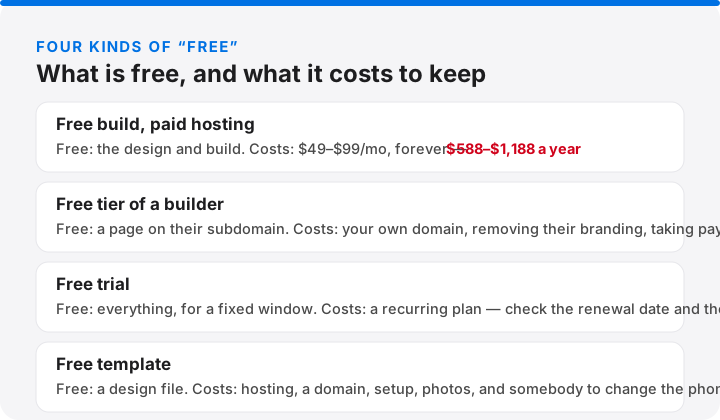
| Kind | What is actually free | What it costs to keep | Watch for |
|---|---|---|---|
| Free build, paid hosting | The design and build work | A monthly fee, forever. The site ranking at the top of this search advertises a 3-page site as “Normally $2500 -NOW- 100% FREE” with $49/mo hosting, rising to $99/mo for 20 pages. That is $588–$1,188 a year. | Whether the monthly is cancellable, and what you keep if you cancel |
| Free tier of a builder | A live page on their subdomain | Your own domain, removing their branding, and taking payments are normally paid upgrades | The plan page, not the ad. Free tiers change; read the current one |
| Free trial | Everything, for a fixed window | A recurring plan. 247PRO, for example, advertises a “free 14-day trial” and says the website builder is included with its paid monthly or annual plan — that plan’s price is not stated on the page making the offer | The renewal date and the price you have not been shown yet |
| Free template | A design file | Hosting, a domain, setup, photos, and somebody to change the phone number in two years | That a template is not a website. It is homework |
None of that is a scam. A vendor who builds you a real site and charges $59 a month to host, secure and maintain it is selling a normal service at a normal price; calling it “free” is just how the category advertises. The failure mode is not being cheated. It is signing up without noticing which of the four you bought, and finding out in month seven.
How do you find the real price in five questions?
Ask these before you give anyone your business name. A vendor selling something real will answer all five in one email.
- What do I pay in month 13? Not the setup, the recurring number. Multiply it by 12 and compare that to what a job is worth to you.
- If I cancel, what do I keep? The domain, the photos, the written content, the reviews, the customer records. Ask for each one by name.
- Whose name is on the domain registration? Yours as registrant, or theirs? This is the single question that decides whether leaving is a Tuesday afternoon or a legal problem.
- Whose phone number is on the site? If they put a tracking number on it, you lose that number when you leave, and every printed truck door, business card and old review pointing at it.
- Is it exclusive, and is there a commission? Some free-site offers are lead-generation deals in disguise, where the site is free because the leads are sold. That can be a fine trade. It should be a decision, not a surprise.
Does a contractor website legally need a license number in California?
Yes. If you hold a CSLB license, your website is advertising, and California requires your license number on it. This is the part that no free-template gallery mentions, and it is the cheapest thing on this page to fix — it is a line in your footer.
The rule is Business and Professions Code section 7030.5:
Every person licensed pursuant to this chapter shall include his license number in: (a) all construction contracts; (b) subcontracts and calls for bid; and (c) all forms of advertising, as prescribed by the registrar of contractors, used by such a person.
“Advertising” is defined broadly enough that a website is plainly inside it. Section 7027.1(b) defines advertising to include the issuance of any card, sign or device, any marking on a building or structure, anything in a newspaper or magazine, anything “by airwave or any electronic transmission,” and any directory listing for construction work — and it adds the phrase that closes the loophole most people reach for: “with or without any limiting qualifications.”
What if you are not licensed yet?
You may still advertise, but only inside a narrow lane. Section 7027.2 permits an unlicensed person to advertise for work where the aggregate contract price for labor, material and all other items is less than $1,000, and only if the advertisement states that the person is not licensed. That $1,000 figure is current: AB 2622 raised it from $500 effective January 1, 2025. Advertising outside that lane is a misdemeanor under 7027.1, carrying a fine of not less than $700 and not more than $1,000.
One number that changed this year
If you have read an older page quoting a $100–$5,000 civil penalty range for CSLB citations, that page is now out of date. Section 7099.2, operative July 1, 2026, sets the general civil penalty at not less than $500 and not more than $8,000, and $1,500 to $30,000 for violations of sections 7110, 7114 or 7118. The statute also allows the amounts to be adjusted for inflation every five years.
This is not legal advice, and CSLB decides what it enforces and how. Read the statutes at the links above and check your own license status at CSLB’s license lookup. The practical takeaway is small and free: put your license number in the site footer so it appears on every page, and on your contact page.
What does a free template not give you?
A template gives you a look. What loses you jobs is usually not the look.
- A booking flow that matches how you actually sell. This is the one most builders get wrong, because they only build one kind. A salon, nail studio, massage practice or dental office sells fixed slots — the customer picks 2:30pm on Thursday and that is the transaction. A plumber, HVAC company or general contractor sells arrival windows and quotes. Ask a burst-pipe caller to choose a 30-minute appointment slot and you have invented a reason for them to close the tab.
- Speed on a phone, on cellular, in a driveway. Google publishes the thresholds it considers good, measured at the 75th percentile of real visits: Largest Contentful Paint under 2.5 seconds, Interaction to Next Paint under 200 milliseconds, and Cumulative Layout Shift under 0.1. A hero-video template on a cheap shared host misses all three.
- Buttons a thumb can hit. WCAG 2.2 success criterion 2.5.8 sets the minimum target size at 24 by 24 CSS pixels. Your customers are often calling you one-handed while holding something.
- Your reviews on the page, not three clicks away on another site.
- Somebody to change it. Prices move, services get dropped, a phone number changes. A template you cannot edit yourself becomes a lie about your business roughly a year after launch.
Should you build a website or fix your Google Business Profile first?
Fix the Google Business Profile first. It is free, it takes an afternoon, and it is increasingly where the customer forms their first impression — before they ever reach a website. Here is how a profile and a website actually compare, and what each one is for.
Search Engine Land reported on July 15, 2026 that google.com had become the second most-cited domain inside Google’s own AI Mode, with citations to Google’s pages growing 8.4 times between April 15 and June 30, 2026, and that the growth came almost entirely from two surfaces: Google Business Profiles and product knowledge panels. Home services was named among the industries most affected. Treat the framing with the appropriate suspicion — the data came from Profound, a company that sells AI-search visibility tracking, so a finding that AI search now needs monitoring is commercially convenient for them. The underlying mechanism is easy enough to check yourself: search your own trade in your own city and see how much of the answer arrives before any website does.
The honest conclusion is neither “so you do not need a website” nor “so websites matter more than ever.” It is this: your Google Business Profile is increasingly where you get found; your own page is where you get booked, and where you keep proof you own. So build the booking page, not the brochure homepage. A five-page site describing your commitment to quality does nothing that a well-filled Google profile does not already do better.
What we give away, and what we do not
Since this page is on our site, here is our own offer stated the same way we just asked you to interrogate everyone else’s. My Nearby Pro builds you a free site with online booking: you answer four questions, it goes live at a mynearbypro.com address, there is no credit card, and you can edit it afterwards from your own dashboard. Appointment alerts are included. Our industry pages cover both sides of the split above — appointment-based trades and dispatch trades get different booking forms, because they are different businesses.
What we will not claim: we are not going to show you customer results we do not have yet, and this is a young product. If you want your site on a domain you own rather than a mynearbypro.com address, ask us about it directly rather than assuming either answer. That is exactly the question we told you to ask everyone else.
FAQ
Is a free website for contractors really free?
Usually the build is free and keeping it online is not. The top-ranking offer for this search gives away a 3-page site and charges $49 a month to host it, rising to $99 a month for a 20-page site — $588 to $1,188 a year. Free builder tiers are genuinely free but leave you on their subdomain with their branding, and charge for a custom domain. Free trials turn into paid monthly plans. Ask what you pay in month 13, not month one.
Does my website need my CSLB license number in California?
Yes. Business and Professions Code section 7030.5 requires a licensed contractor to include the license number in all construction contracts, subcontracts and calls for bid, and all forms of advertising. Section 7027.1 defines advertising broadly enough to cover electronic transmission and directory listings, “with or without any limiting qualifications.” The simplest fix is to put the number in your site footer so it appears on every page.
Can I advertise a construction business if I am not licensed?
Only within a narrow exception. Section 7027.2 allows an unlicensed person to advertise for work where the aggregate contract price for labor, material and all other items is under $1,000, and only if the advertisement states that the person is not licensed. AB 2622 raised that threshold from $500 effective January 1, 2025. Advertising outside that lane is a misdemeanor under section 7027.1, with a fine of $700 to $1,000.
Who should own my domain name?
You, as the registered registrant. A domain registered in a vendor’s name is the most common way a cheap website becomes expensive later: the site can be rebuilt in a day, but a domain you do not control takes negotiation or legal help to recover, and every printed card and old link points at it. Ask for the registrant name in writing before you sign anything.
Do I need a website if I already have a Google Business Profile?
Start with the Google Business Profile, because it is free and it is increasingly where customers form a first impression. But a Google-hosted card cannot take a booking on your terms, cannot show your own proof, and can be changed or suspended without your say. Treat the profile as where you get found and your own page as where you get booked.